Saturday, 9 February 2013

Still life drawing–the simple things in life

If you are in London before 7th April and enjoy looking at still life drawings, seek out this delightful little gallery - the Estorick Gallery in Islington which is showing quite a large exhibition of drawings and etchings by the Italian artist, Georgio Morandi. His subject was a group of simple domestic objects which he used for most of his artistic life. He was known as the 'bottle painter'. He worked during the first half of the 20th century - so don't expect conventional drawings. www.estorickcollection.com

If you are in London before 7th Aril and enjoy looking at still life drawings, seek out this delightful little gallery - the Estorick Gallery in Islington which is showing quite a large exhibition of drawings and etchings by the Italian artist, Georgio Morandi. His subject was a group of simple domestic objects which he used for most of his artistic life. He was known as the 'bottle painter'. He worked during the first half of the 20th century - so don't expect conventional drawings. www.estorickcollection.com

I enjoyed this exhibition so much that I spent the next day – yes a whole lovely day – drawing my own group of objects. I was particularly inspired by how Morandi used the negative spaces between objects and how the shaded areas of a 3D form was allowed to merge into this negative space, giving the objects ‘character’. Here is my drawing gallery, each on A2 lining paper, also showing the still life group which I placed on a mirror surface.

Flying feathers

The full length sliding doors at the end of my studio are ideal for showing marks on layers of translucent materials and extend my working  pin board.

These layers are A1 sized tissue paper and tissutex (the reinforced tissue paper that a slightly fibrey, natural coloured white surface): sometimes two layers and sometimes a few more. Too many layers and the marks are lost and the layers become too dense and lose their translucency.

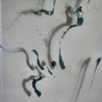
The marks are drawn with a large seagull feather dipped in a black drawing ink, making large radiating movements of my arm and the odd ‘flick’ of the wrist. I was pleased when I was able to control the feather to make sweeping arcs that are suggestive of movement and flight.

Most were drawn through two layers of tissue, allowing the mark to dissipate a little through onto the under layer. This has often given an interesting intermittent effect as the ink is less effective - I almost prefer this type of mark. Many drawings later, I sorted through them to select the most successful, cutting some into vertical quarters and re-arranged into layers, sometimes swapping the layers around so the more interesting marks on the under-layers appear on the top when clipping them together for these photos.

Thoughts for development -

Make similar marks on organza and re-create these effects?

Where is the stitch? Add my loopy stitches alongside marks? Forget the stitch element? Use stich in the voids to suggest sky? Is this too corny?

Talking these questions through with my studio assistant, I think I should try it on the fabric first and take stock. Usually when I have published a blog posting and I re-read it, I can immediately see  the answer to my doubts.  So here goes…..’publish’!

Saturday, 26 January 2013

How are we doing?

P1060311

Splashy and I have been spending time together this afternoon, moving a few ideas around – in my head, on the table and re-arranging my pin board – a very important activity in helping me to sift and evaluate my ideas.

I devised a back-saving working surface by raising an A1 drawing board up a few inches so I could work standing up which I prefer when using paint brushes and making large movements.

Painted curved trial lines onto several pieces of silk organza – based on the series of drawn lines already on pin board - perhaps it was also influenced by  that flicking tail I could see out of the corner of my eye.

Pegged them out to dry, using the radiator rack over the display board. Looking forward to playing with those tomorrow.

I’ve continued pulling threads in the painted linen scrim strips and am interested in how this way of manipulating the line can create rhythms and movement.

Saturday, 19 January 2013

Developing the line

studio cat

As the snow slowly disappears and looks less interesting to call me out doors, I’ve spent the afternoon going through some plan chest drawers (with my studio assistant) to seek out exploratory (and unresolved) work I did a couple of years ago at a drawing workshop with Audrey Walker.

I was pleased to remember that this work involved explorations of ‘line’ that suggests rhythm and movement. I was actually looking at the threads in the edge of a ripped fabric, but a whole weekend of total absorption in this, allowed a bit of a creative burst to develop these lines into bigger ideas.

The activity of looking at these drawings (and some stitched bits) and sorting and placing them together has allowed me to establish interesting connections and perhaps open up a few thinking ‘doors’.

I’ve made one amusing connection between the rhythm of the repeating curves in the drawings and the clutch of curved willow hanging ‘out of the way’ on my pin board – seen in the last image. So they might be brought into play some time soon!

Friday, 18 January 2013

Putting my best foot forward…

mukluks

……wearing my old mukluk boots bought for skiing holidays in the ‘80’s, a trek along Park Lane with camera to capture the imprints made by cars and tractors in the snow.  The trivial things in life are good aren’t they.

Hope you’ll be able to enlarge all of these.

Thursday, 3 January 2013

Drawings

Marks to suggest the swooping flights of flocks of starlings.