Thursday, 10 October 2019

Story development


I'm continuing to experiment with my chosen materials to test ways in which I can use them to make a whole variety of fascinating sculptural configurations. It's a challenge to persuade myself to notice new things that happen as I work - to allow a fresh thought to emerge - as if for the first time.

It is important to me to give my art pieces a connection with an idea, thought or story. I hope this suggests a thought or idea that engages the viewer beyond the visual presence of the art work.

I have been very aware of the polluting effect of the mass of discarded plastic thrown out in the seas that have been damaging life in the oceans and coastlines. So I was keen to make this current work with plastic materials reach out further to the viewer than the immediate physical fascination with my use of plastic materials.

I tried different ways of transforming the plastic surface by sanding down the shiny surface to a matt effect that was then receptive to to marks made with inks such as made in the sketchbook with a feather dipped into inks.


Cutting up the plastic bottles in different ways gives numerous pieces that could be stitched or laced together. I hoped this element would add an element to an underlying message related to a shape that was broken down, fragmented, discarded, cracked, dismembered, dissolved and disintegrating: maybe a list of words that could relate to how the ecological system was breaking down.

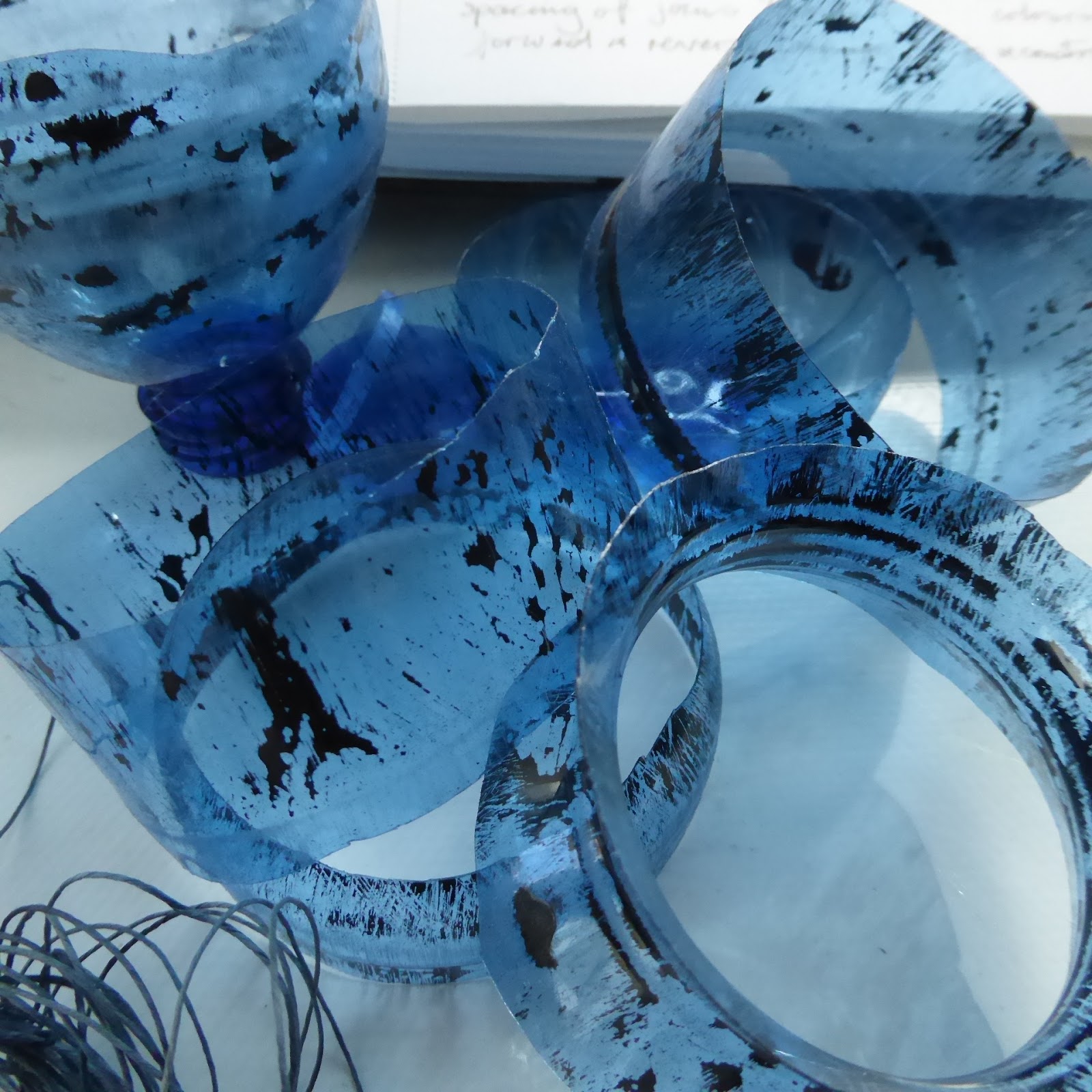
                        
Playing with the fragments of plastic bottle gave me the chance to look at ways of re-joining these shapes into the original form with associated meanings of 'mending' or 'making better' perhaps. I'm intrigued by ways of suggesting the idea of 'change', forming a gradual movement of one state to another. 

This ecological project seems to ask the question of how changes will occur and so I am keen to try to make my materials show changes by adding or subtracting, modifying sizes, intensifying colour. I need to observe what is happening in my hands - not wanting to miss the accidental, unpredictable and probably the most intriguing part to the process. I find this a more rewarding and creative way of discovery than to anticipate and guess what I think should happen.

Making rows of small holes around the edges of the cut shapes allowed me to thread or lace together with the debate of whether to make perfect or whether to allow spaces and gaps to form distorted or corrupted versions of the original.


It was very revealing to see what happened when twisting and making the shapes distort from the bottle shape and exciting to find shadows on my sunny working table.......
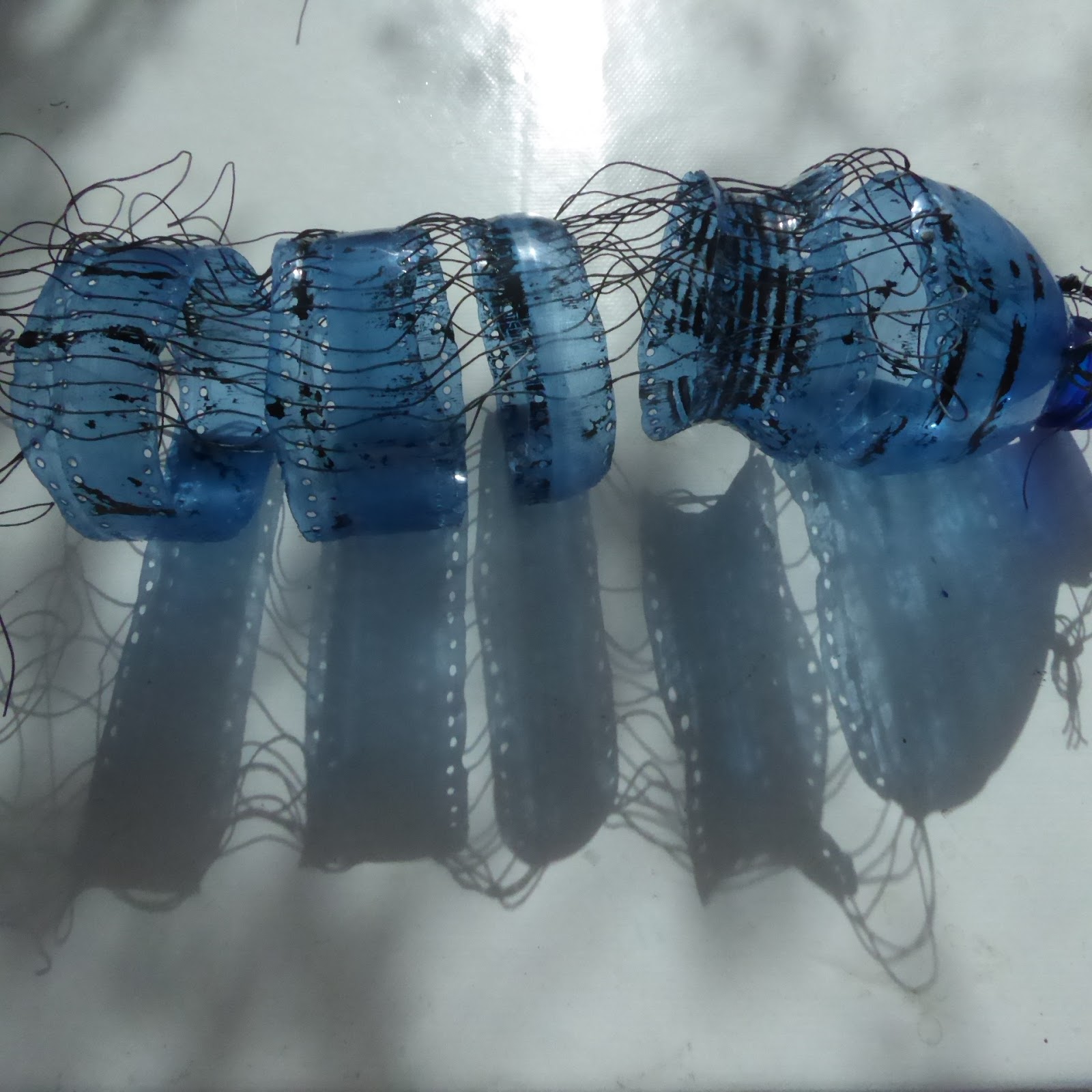

..... and dramatic lighting through the translucent materials showing the sanded and scratched surface of the plastic surface.


Monday, 30 September 2019

Stretching

Looking back at previous investigations into plastic surfaces, I re-looked at these samples where lines of perforations were made into black bin liner plastic, stretched on the ironing board and ironed between baking parchment.

Tried it again on a white plastic that I'd printed with a feather.

I found that 'flicking' ink marks with feathers onto paper and plastic made interesting marks
and then onto a plastic bottle which I hoped would give it a suggestion of a feathered surface to relate to a bird.


Sunday, 29 September 2019

Control or not

You might think this is a lovely free style drawing of a heap of bottles. It is done without control with my poorly plastered hand and wrist. Not as bad as I'd anticipated but a very different experience from before the accident.
Am I learning the secret of how to draw with more characterful lines and not to make too precise a record? Slowness of working gave opportunities to come upon ideas as if for the first time.

Ripped shapes from papers previously decorated by printing with crumpled plastic. Lack of control of ripping process creates loose shapes based on silhouettes of plastic bottles.
Marks and rips perhaps suggesting the break down of the plastic shapes.
The incidental effects were food for thought.


Saturday, 28 September 2019

While two hands still available

I've been working with two artist friends, Pauline Lerry and Lesley Roberts for several years, meeting together to draw, ponder and explore different topics. Sometimes we chat and sometimes we just concentrate, sometimes we eat cake and drink coffee. Although we all have our own studio spaces in our own homes, the 'coming together' from time to time in a local church hall seems to give us a special bonding atmosphere of mutual creative thinking. 

This working relationship led us to arrange a common project which I've described earlier in this blog based on a study of the newly formed local wildlife and wetlands area on the north Somerset coast at Steart Marshes. We called the exhibition that evolved from this 'Change'.

To continue the idea of working together, a second exhibition topic was discussed based on environmental issues. All three of us wanted to respond to individual aspects of this vast topic. Pauline decided to look at the changing of sea levels; Lesley to look at the disappearing wild flower meadows and I to look at ideas based on the pollution of plastic on our coastline.

So making a start on my own topic, I started to look around for to see where and what sort of plastic items were being discarded on our beaches.


My foraging during last summer and into the winter seemed to produce mainly plastic bottles amongst pebbles and sea grasses in the coastal stretches I visited initially.I had many plastic containers at home too as well as plastic carrier bags I was re-using. An unattractive and unpleasant collection which wasn't at all inspiring, so a lot of thinking needed to be done to come to terms with how I should approach this topic.

This project is in response to the destructive deluge of waste plastic, particularly in the sea and particularly for wildlife.This is a fresh project although part of an on-going passion for conservation, an underlying theme for most of my work in recent years. 

I am filtering ideas to select a particular 'angle' for my research into a new material for me - plastics. I plan to focus on the discarded plastic bottle and its impact on the ea and coastline, and the plight of birds and fish.

I've been doing a lot of thinking and reading rather than my usual approach to jumping straight in to play with materials that then inform and help to develop ideas. Perhaps my difficulty in handling materials due to the broken wrist gave me an ideal opportunity to hesitate and ponder more deeply. The knack of noticing and absorbing small detail feels the right way to make progress within a personal landscape of thinking in which it feels I am able to fit comfortably.

Keep reading.


Friday, 27 September 2019

Returning to my story

It’s been so long since I posted anything. Recovery from my broken wrist is my main excuse and then when I was finally able to use my right wrist in July last year I’ve been so busy producing stuff … well you’ll know the old excuse!!

My on-going passion for environmental issues continued into a large scale project that I exhibited with the 62 Group of Textile Artists in a touring exhibition starting at MAC in Birmingham, moving to the National Centre of Craft and Design Centre in Sleaford, Lincolnshire and currently opening in Scunthorpe.

Here is an image of ‘Rolling out a carpet of hope’ shown at the NCCD, next to a window  that showed how the tree outside blossomed to match my piece.

This 4 metre long installation of dyed cane structures is a response to the major UNESCO project to plant saplings across the desert band of Africa to try to re-store fertility to the dehydrated land.


A few close-up images to show details, starting with a page from my sketchbook where I started to make marks with inks and wires that indicate tree forms. 


The close-up image above shows the early stages of growth and the following stages of blossoming growth.


An intimate connection with materials is always an important factor when evolving and idea for a specic project


Tuesday, 27 March 2018

Making my own painting materials

P1040486

It seemed a good idea to continue drawing from my chosen landscape by using parts of the landscape as my medium. A really great idea from Debbie Lyddon to make a proper paint from the mud seemed an intriguing idea and superior to the rather rough method I used earlier of rubbing the wet mud directly onto the paper or fabrics.

I started off by grinding some dried mud into a fine powder using a smooth pebble.

P1060040 P1060042

Then adding two ingredients to make a solid paint block – a teaspoon of honey and of gum arabic mixing together to make a stiff gunge which set to a solid block.

brushes

Below: marks made with mud paint using feather paint brush with added black wire.

P1060066

Below: as above but also with twiggy on the rightwith added black wire.

P1060068

Below: stumpy, twiggy and added wire plus paper fragments

P1060069

Below: wax, oil crayon, feather paint brush and spikey twig.

P1060070

Below: scratched paper surface with mud wash and black wire.

P1060067

Below: scratched paper surface with mud wash.

 P1060060

Below: wax, oil crayon, feather paint brush and spikey twig.

P1060072

Monday, 16 October 2017

Views of ‘Change’ exhibition at CICCIC gallery in Taunton

three  Sian

20170924_123244Posing for photographs is never easy when trying to look ‘relaxed’ and ‘natural’ by photographers.

Lesley and I pushed Pauline forwards when a live interview was needed by the ITV cameraman. She did exceptionally well and we saw her on the West Country news that evening.


Thank you to everyone who came to view the exhibition and all the wonderful comments you eft in our visitors’ book.

DSC_7397

From Lynda Duthie -

"You have the edge on most venues and collectives because your exhibition is not just a random collection of pieces of your various work.  You have done this as a collective over a whole year; it is considered; you know each other well, you work well together and your varied talents complement each other.  It shows! You must know that it is already a success but you all deserve good, appreciative audiences and acknowledgement of what you have achieved!"

From Jenny Blackburn -

"I have just got back from visiting your exhibition - Congratulations , it's a knock out. By far the best thing I have seen in Arts Week for several years. You must be very pleased with it."

From  Elizabeth Fortescue -

"This is very exciting. Three complimentary artists looking in detail with their differing textures and lines. Fantastic collage photography - new to me and very successful - Pauline's quality of line and subtle colour and Siân's beautiful textural sculpture. Thank you for your inspiration"

P1050283

The gallery had three long walls – one for each of the three artists. This was my wall – a continuous long white area, lit by overhad spots that made the shadow potentila of my linear pieces very dramatic.

20170924_160936

20170924_16104420170924_16113320170924_161144

20170924_161206

Groupings seemed to work well too. Here you can see ‘Getting there’ above the spiralling ‘Freedom’ with two smaller ‘Landing’ and ‘Taking Off’ pieces.

P1050262

Thank you for all the advice on Facebook as to how many layers to present these ‘Stars of Steart’.I layered two in the outside stars (seen as a single image below) and a single layer in the centre one.

P1050268

P1050269